Whitehot Magazine
June 2026
"The Best Art In The World"
"The Best Art In The World"
June 2026
February 2009, The Now Museum: The Student of Prague
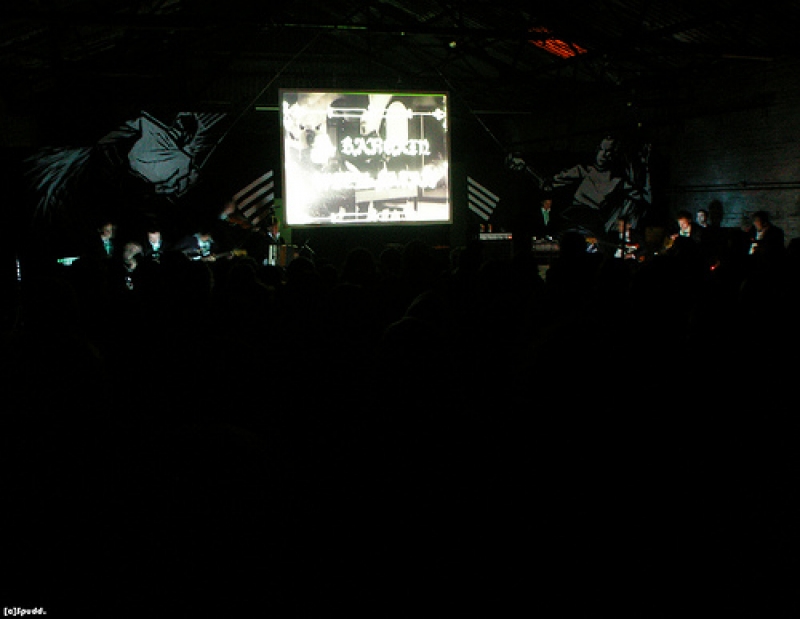
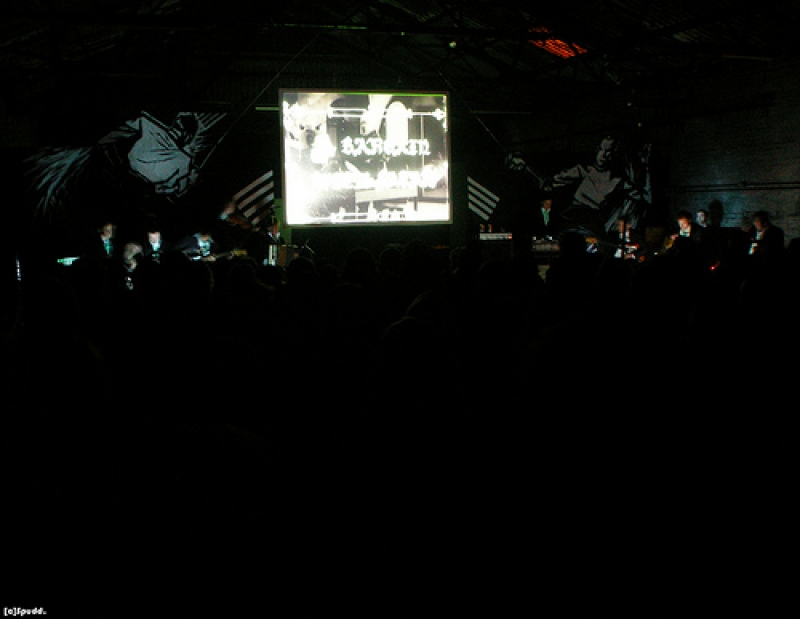
Der Student von Prag, Photo credit Spudd
The Now Museum: The Student of Prague
The flickering light of candles illuminates the old ice cream factory. Dusty wooden boards on worn-out tyres invite the audience to sit down. In front of them, two larger-than-life fencers, black and white illustrations on cardboard, set the scene for the premiere of a truly memorable performance, which merges fine art, music and film.
With the first notes of music and the rattling sound of a film projector the screening of Der Student von Prag (The Student of Prague) begins. The art performance surrounding the 1913 black and white film, which attracted about 200 visitors on November 7 and 8, 2008, was also the launch of the Now Museum, Glasgow’s latest art event - and studio space. The artistic set design, redesigned intertitles, and a new live music cast shed a fresh light on Stellan Rye’s almost forgotten silent movie.
The Faustian story of this horror film is set in 19th century Prague. Best student and fencer in town Balduin sells his mirror to sorcerer Scapinelli in exchange for fortune and the woman of his dreams. The reflection begins to haunt Balduin, appearing with greater frequency and ruining his life until the desperate student shoots his doppelganger and thus kills himself.
Canadian illustrator Judd Brucke and English artist Jack Wrigley, initiators of the performance, decided to reinterpret the pre-expressionist film when watching it together. “We liked the cinematography,” the two remember, “but its cheap music cast and blunt intertitles were not good. It seemed to show no respect to the film.” Therefore Jack and Judd decided to create a new setting for these black and white moving pictures, which seem so delicate as if their ghostly appearance was about to vanish from the celluloid.
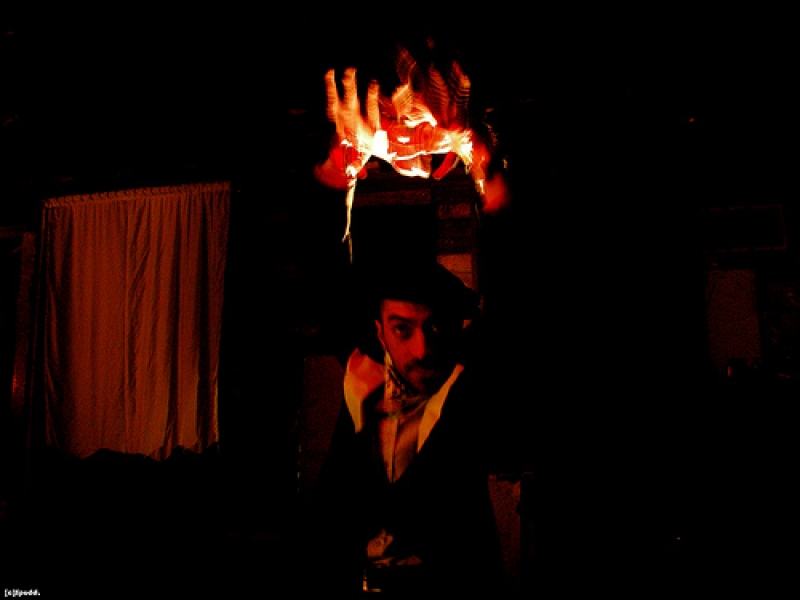
Judd created visuals that fully embellish the romantic 19th- century scenery of the film. Squiggly calligraphy replaces the film’s blunt intertitles and the dynamic, powerful illustrations surrounding the screen remind one of expressionist wood cuts. In the most dramatic scene of the film, another artistic tool of the past is used: the shadow theatre. When Balduin is running through the nocturnal streets of Prague, haunted by his doppelganger, fiery music, horror-stuck eyes, two shadows appear above the projection screen, hands that seem to tighten around the protagonist’s neck and highlight the drama of the film’s catastrophe.
In contrast to the visuals, the music was jointly created by ten musicians. They all were aligned to a certain character – base, electric guitar and saw for the villain Scapinelli, piano for Balduin, electric guitar for his doppelganger, violin and accordion for gypsy-girl Lyduschka, synthesiser for the beloved countess Schwarzenberg, as well as base and acoustic guitar for Balduin’s rival, count Schwarzenberg. While the piano sounded like it could even have been part of the original score, its counterpart, the electric guitar of Balduin’s doppelganger reminded one more of 1980s rock classics. “Because it is a juxtaposition of music from different times it becomes a music cast of no specific time,” Jack explains, “I think it works surprisingly well together and challenges what you would expect.”
This challenge of the audiences’ expectation was one of the major aims of the performance. “If it doesn’t shock, we failed our job,” says Judd jokingly. He and the group see the project as a reaction against the predictability of mainstream cinema. Although it is arguable that this production is “anti-cinema” (quote Judd), the setting is definitely badly heated, dirtier and with a DIY-character which contrasts significantly with the plushy, impersonal cine-complex experience.
Maybe Jack’s romantic description is more suitable when he says they were interested in recapturing the magic of cinema by creating a spectacle, something unique. “I don’t remember anything like that having been done before, to have something live, redoing a full score, giving it more ‘colour’ – although we really want more black and white,” says Judd waggishly. “There have been projects at cinemas including live music, but nothing that went as deep.”
Apart from reminding the audience that cinema has not always been as smooth and high-tech as it is today, the film itself still holds its social relevance. The old issues are also contemporary issues, like the doppelganger-motive. Balduin’s dual role was only made possible by the advance of technology, in this case the multiple exposure technique. Similarly, today technical representation is driven to new heights in times of internet platforms like Myspace and Facebook. Nowadays the question could be what happens if you ‘shoot’, meaning delete, your Facebook alter ego?
The group project “Der Student von Prag” was the first of a series of performance-based exhibitions at the Now Museum, whose name is an ironic hint at the common understanding of art. The ‘museum’ is situated in a former ice-cream factory in Glasgow Partick.
whitehot gallery images, click a thumbnail.